
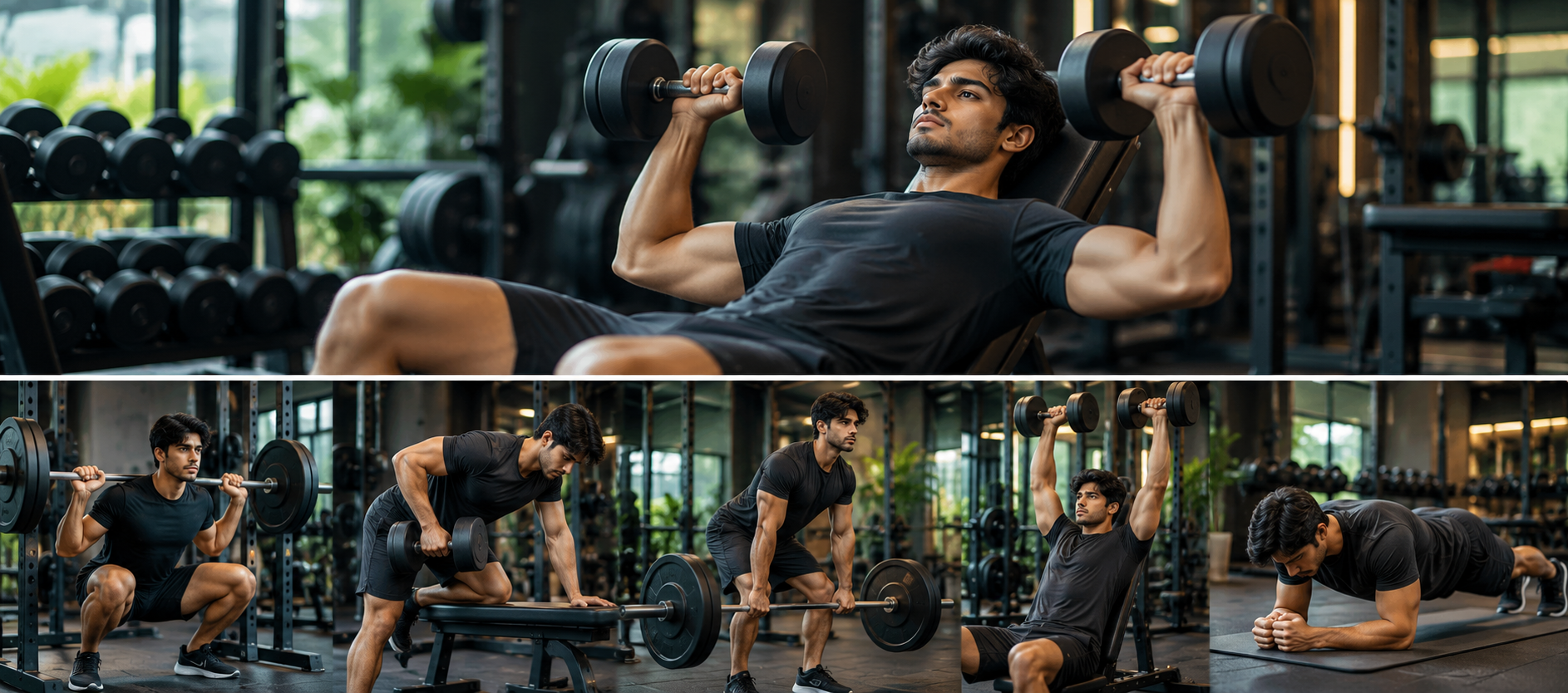
Strength training is a form of exercise where your muscles work against resistance. That resistance can come from dumbbells, barbells, machines, resistance bands, kettlebells, or even your own body weight.
You don’t need to be an experienced athlete to start strength training. In fact, beginners can make excellent progress by following a simple program and focusing on consistency.
Whether your goal is to build muscle, lose body fat, become stronger, improve your fitness, or simply feel better, strength training can become an important part of your routine.
The biggest mistake beginners make is thinking they need an advanced workout program from day one.
You don’t.
You need a plan that you can understand, perform safely, track and repeat.
Why Is Strength Training Important?
Strength training offers benefits beyond building visible muscle.
1. It helps you become stronger
Regular resistance training teaches your muscles and nervous system to work together more effectively.
Over time, everyday activities such as carrying bags, climbing stairs, lifting objects or playing sports can become easier.
2. It helps build and maintain muscle
Resistance training provides a stimulus for your muscles to adapt.
When combined with appropriate nutrition and recovery, consistent training can help you build muscle.
3. It can support fat loss
If your goal is to lose fat, strength training can be extremely useful.
During a fat-loss phase, resistance training can help you maintain muscle while your overall body weight decreases.
However, remember that strength training alone does not automatically cause fat loss. Your overall calorie intake, activity level and diet matter.
4. It improves physical performance
Getting stronger can improve your ability to perform other activities such as running, hiking, sports and recreational activities.
5. It supports long-term fitness
Strength is useful throughout life.
Building a strong foundation when you are younger can help you maintain physical capability as you get older.
How Often Should You Do Strength Training?
If you’re a beginner, 2–3 strength-training sessions per week is a good starting point.
For example:
Monday: Full Body
Wednesday: Full Body
Friday: Full Body
You don’t need to train the same muscles intensely every day.
Recovery is part of the process.
A general guideline from the World Health Organization recommends adults perform muscle-strengthening activities involving all major muscle groups on at least two days per week.
The ideal frequency depends on your experience, schedule, recovery and goals.
The best workout schedule is ultimately the one you can follow consistently.
The Best Strength Training Exercises for Beginners
You don’t need dozens of exercises.
Start by learning basic movement patterns.
1. Squat
Squats primarily train the lower body, including the quadriceps and glutes.
Beginners can start with:
- Bodyweight squats
- Goblet squats
- Machine squats
- Barbell squats
Beginner target
3 sets × 8–12 reps
Focus on controlled movement rather than lifting the heaviest possible weight.
2. Push-Up or Bench Press
These movements train the chest, shoulders and triceps.
Beginners can start with:
- Wall push-ups
- Incline push-ups
- Regular push-ups
- Dumbbell bench press
- Machine chest press
Beginner target
3 sets × 8–12 reps
Choose the variation that allows you to maintain good technique.
3. Row
Rows develop the muscles of your upper back and arms.
Good beginner options include:
- Seated cable row
- Chest-supported dumbbell row
- One-arm dumbbell row
- Machine row
Beginner target
3 sets × 8–12 reps
Avoid using excessive momentum to move the weight.
4. Hip Hinge
Learning the hip-hinge movement is important for developing the posterior chain.
Exercises include:
- Romanian deadlift
- Dumbbell Romanian deadlift
- Kettlebell deadlift
- Conventional deadlift
Beginner target
2–3 sets × 8–12 reps
Start light and learn the movement before increasing the weight.
5. Overhead Press
The overhead press trains the shoulders and triceps while requiring your core to stabilize your body.
You can use:
- Dumbbells
- Barbell
- Machine
- Resistance bands
Beginner target
2–3 sets × 8–12 reps
Don’t lean excessively backward to complete repetitions.
6. Core Exercise
A strong core helps you control your body during many movements.
Beginner-friendly options include:
- Planks
- Dead bugs
- Bird dogs
- Cable Pallof presses
Beginner target
2–3 sets
Focus on controlled movement rather than simply holding a position for as long as possible.
A Simple 3-Day Strength Training Plan
If you’re new to the gym, you can start with a full-body program.
Monday — Workout A
Goblet Squat
3 × 8–12
Dumbbell Bench Press
3 × 8–12
Seated Cable Row
3 × 8–12
Romanian Deadlift
2 × 8–12
Dumbbell Shoulder Press
2 × 8–12
Plank
2–3 sets
Wednesday — Workout B
Leg Press
3 × 8–12
Lat Pulldown
3 × 8–12
Incline Dumbbell Press
3 × 8–12
Dumbbell Romanian Deadlift
3 × 8–12
Lateral Raise
2 × 10–15
Dead Bug
2–3 sets
Friday — Workout A
Repeat Workout A.
The following week, start with Workout B.
This gives you a simple alternating structure:
Week 1: A → B → A
Week 2: B → A → B
You don’t need to constantly change exercis
How Many Sets and Repetitions Should You Do?
There isn’t one magical number of sets and reps that works for everyone.
For beginners, 2–3 sets of roughly 8–12 repetitions is a practical starting point for many exercises.
The load should be challenging enough to stimulate adaptation while allowing you to maintain good technique.
You should not feel that every set needs to be an all-out maximum effort.
As your experience increases, your training volume and exercise selection can become more individualized.
What Is Progressive Overload?
One of the most important concepts in strength training is progressive overload.
Progressive overload means gradually increasing the training challenge over time.
You can progress by:
- Adding weight
- Performing additional repetitions
- Increasing sets
- Improving technique
- Increasing range of motion
- Using a more challenging exercise variation
For example:
Week 1: 10 kg × 8 reps
Week 2: 10 kg × 10 reps
Week 3: 10 kg × 12 reps
Week 4: 12 kg × 8 reps
This is only an example.
Your progression should be based on your own ability.
Don’t increase the weight simply because someone else in the gym is lifting heavier.
How Heavy Should You Lift?
This is one of the most common beginner questions.
The answer is simple:
Use a weight that you can control.
When learning a new exercise, start conservatively.
Your first priority should be:
Technique → consistency → progression
Not:
Maximum weight → poor technique → injury
For many exercises, you can finish your set feeling like you could still perform a few good repetitions.
As you gain experience, you can gradually increase the challenge.
How Long Should a Strength Workout Last?
You don’t need to spend two hours in the gym.
A beginner session can often fit into 45–60 minutes.
For example:
5–10 minutes: Warm-up
30–40 minutes: Strength training
5–10 minutes: Cool-down/easy movement
Your workout duration will depend on how many exercises you perform, how long you rest and how busy your gym is.
Don’t judge your workout by how long you stayed in the gym.
Judge it by whether you trained effectively and consistently.
Strength Training and Fat Loss
If your primary goal is losing body fat, don’t make the mistake of thinking you need to do endless cardio.
Fat loss primarily depends on maintaining a sustainable calorie deficit over time.
Strength training can complement that process by providing a reason for your body to retain muscle while you lose weight.
A sensible fat-loss approach can include:
Strength training + adequate protein + calorie control + daily activity + recovery
This is generally more sustainable than relying on extreme workouts or restrictive diets.
Nutrition for Strength Training
Training is only one part of the equation.
Your body needs energy and nutrients to recover from exercise.
A balanced diet can include:
Protein
Examples:
- Eggs
- Chicken
- Fish
- Lean meat
- Greek yogurt
- Dal
- Beans
- Soy foods
Carbohydrates
Examples:
- Rice
- Oats
- Potatoes
- Fruits
- Whole grains
- Roti
Healthy fats
Examples:
- Nuts
- Seeds
- Olive oil
- Avocado
- Fatty fish
Vegetables and fruits
These provide important vitamins, minerals and fiber.
You don’t need a “perfect” diet.
You need a diet that supports your goals and that you can maintain.
Don’t Ignore Recovery
Your workout provides the stimulus.
Recovery gives your body the opportunity to adapt.
Important recovery habits include:
- Getting adequate sleep
- Eating enough nutritious food
- Staying hydrated
- Managing training volume
- Taking rest days when needed
If your performance is continually declining and you’re constantly exhausted, adding more training isn’t necessarily the solution.
Sometimes you need more recovery.
7 Common Strength Training Mistakes
1. Ego lifting
Trying to impress other people by lifting weights you cannot control is a common mistake.
Train for your progress, not someone else’s approval.
2. Skipping warm-ups
A short warm-up can help you prepare physically and mentally for your workout.
3. Changing your routine constantly
Give your program enough time to work.
4. Training only chest and arms
A balanced program should include your legs, back, chest, shoulders and core.
5. Ignoring technique
Learn the movement before chasing heavier weights.
6. Expecting overnight results
Muscle and strength development take time.
7. Giving up too early
Consistency is one of the biggest advantages a beginner can have.
How to Track Your Strength Progress
Keep a simple training log.
Record:
Exercise: Dumbbell Bench Press
Weight: 12.5 kg
Reps: 10
Sets: 3
Next week, record your performance again.
After several weeks, you can look back and see whether your performance has improved.
You can also track:
- Body weight
- Measurements
- Progress photos
- Repetitions
- Weights used
- Workout consistency
Don’t rely only on the mirror.
Sometimes your strength improves before major visual changes become obvious.
When Will You See Results?
Everyone progresses at a different rate.
Your results depend on factors including:
- Training consistency
- Nutrition
- Sleep
- Starting fitness level
- Genetics
- Training quality
- Recovery
- Age and experience
Beginners may notice improvements in strength relatively quickly as they learn the movements and adapt to training.
Visible muscle development generally requires more time.
Instead of asking:
“How quickly can I transform my body?”
Ask:
“Can I train consistently for the next six months?”
That question will take you much further.
Your First 30 Days of Strength Training
If you’re completely new, keep your first month simple.
Week 1
Learn the exercises.
Don’t worry about lifting heavy.
Week 2
Start recording your weights and repetitions.
Week 3
Try to improve your repetitions or technique.
Week 4
Review your training log and identify where you’ve improved.
Your first month is about building the habit.
You are creating the foundation for the months that follow.
Final Thoughts
Strength training doesn’t have to be complicated.
You don’t need an advanced workout split, expensive supplements or a huge collection of gym equipment.
Start with the fundamentals:
Train consistently.
Learn good technique.
Train your whole body.
Progress gradually.
Eat according to your goal.
Recover properly.
And most importantly, give yourself enough time to improve.
Your first workout may not feel impressive.
That’s okay.
Every experienced lifter started somewhere.
Start where you are. Build strength. Stay consistent. Become better.
Combining strength training with a balanced diet and regular physical activity can support your fitness goals. Read our How to Lose Belly Fat Fast (Complete Beginner Guide 2026) to learn more about effective fat-loss strategies.